

### Blog Post:
Best monitor for Xbox Series X—Choosing the right display can make or break your gaming experience. Whether you want cinematic immersion, razor-sharp competitive responsiveness, or simply the best value, Xbox Series X players in 2024 need to prioritize compatibility and proven performance over pure marketing hype.
Key Takeaways
- Premium Xbox Series X gaming monitors require 4K resolution, HDMI 2.1, 120Hz+ refresh, low response time, and VRR support for a true next-gen console experience.
- Specs alone don’t guarantee performance—input lag and real-world HDR/VRR behavior must be validated through testing and user feedback.
- Warranty, firmware updates, and post-purchase support are major blind spots—buy only from brands with proven policies and responsive updates.
- TL;DR — Best monitor picks for Xbox Series X
- What defines the best monitor for Xbox Series X in 2024
- How to prioritize specs for your use case
- Common user pain points and what to test before you buy
- Price tiers and what you should expect at each level
- Top recommended models and why
- TV vs dedicated monitor — what real users report
- Warranty, firmware updates, and long-term support — what to check
- Real-world testing checklist
- Value picks and alternatives under $500 / $800 / $1,200
- Top 3 informational gaps readers will care about
- FAQ — short answers to the most searched questions
- Sources & further reading
TL;DR — Best monitor picks for Xbox Series X (1–2 lines each)
- Best Overall: ASUS ROG Swift OLED PG27UCDM — 27″ QD‑OLED, 4K, 240Hz, HDMI 2.1, Dolby Vision, top-tier HDR & color. High price, but unmatched versatility.
- Best Value: Gigabyte M32U — 32″ 4K, 144Hz, HDMI 2.1, FreeSync, wide compatibility; sharp price for high-end features.
- Best Budget: AOC 24G15N — 24″, 1080p, up to 180Hz, excellent response, HDMI 2.0; won’t do 4K/120Hz but delivers smooth gaming for under $200.
- Best for Competitive: Samsung Odyssey OLED G8 — 34″ OLED, 175–240Hz, ultra-fast response; for those seeking esports-level speed and immersion.
- Best Cinematic/OLED: Samsung Odyssey OLED G8 or ASUS ROG Swift OLED PG27UCDM — both deliver near-infinite contrast and vivid HDR for movies & storytelling games.
Must-verify for all: Confirm true HDMI 2.1 bandwidth & feature compatibility with Xbox Series X.
What defines the best monitor for Xbox Series X in 2024
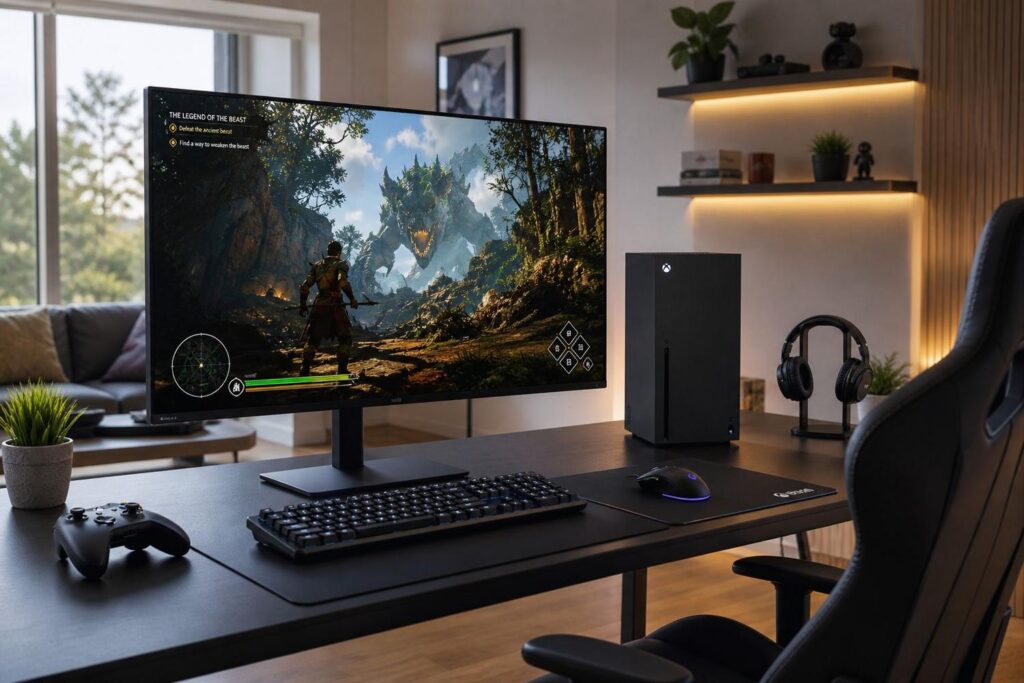
To get the most from your Xbox Series X, your gaming monitor must clear several technical hurdles—otherwise, you don’t fully unlock 4K gaming at high refresh rates or advanced features like VRR and top-end HDR.
- Resolution: 4K (3840 x 2160) is the gold standard. Some QHD (1440p/ultrawide) monitors work, but only 4K delivers the sharpness the Series X can provide.
Source - Refresh Rate: 120Hz minimum is needed for high-FPS Xbox games; 144Hz/240Hz offers even more smoothness and future-proofing.
Source - HDMI 2.1: Absolutely required for 4K at 120Hz. Older HDMI versions cap you at 4K/60Hz or 1440p/120Hz.
Source - Response Time: 0.03ms to 1ms gray-to-gray (GTG) minimizes motion blur and ghosting—critical for shooters and racing games.
Source - HDR: Look for VESA DisplayHDR or Dolby Vision (supported by Xbox). Not all “HDR” labels give real-world impact.
Source - VRR (Variable Refresh Rate): Xbox Series X uses FreeSync (AMD GPU); eliminates screen tearing if the monitor supports it.
Source
Monitor specs can be misleading—many boast fast response but deliver high input lag, poor HDR implementation, or limited bandwidth in real use. Always validate with trusted independent reviews.
How to prioritize specs for your use case (competitive vs cinematic vs budget)
Every Xbox Series X gamer has priorities—here’s how to choose the best monitor for Xbox Series X based on YOUR needs:
- Competitive (FPS, esports): Low input lag, ultra-fast response (0.03–1ms), and 120Hz+ refresh should be your top priorities. G-Sync/FreeSync support is key for stable frames. Sacrifice fancy HDR for speed if needed.
- Cinematic/Immersive: Choose 4K, wide color gamuts, OLED or FALD local dimming, and true HDR (DisplayHDR 600+ or Dolby Vision). 120Hz remains recommended, but exceptional image quality is king.
- Budget/All-purpose: Some 1440p/120Hz or 1080p/144Hz monitors offer great smoothness under $400, but you lose 4K detail and advanced HDR. Accept trade-offs, and confirm VRR and HDMI versions before buying.
According to recent research, HDMI 2.1 and 120Hz refresh are must-haves to leverage the console—and 0.03–1ms response time prevents input lag bottlenecks.
Common user pain points and what to test before you buy
Manufacturer specs rarely match the real-world gaming experience. The most common complaints (and what to test):
- Input lag higher than advertised: Specs might claim 1ms, but console mode can introduce extra lag. Test with an input lag meter or search review sites for real Xbox measurements.
- Screen tearing or VRR bugs: FreeSync/G-Sync might not work flawlessly—watch for flicker or micro-stutter at 120Hz with VRR enabled.
- Unimpressive “HDR”: Many budget monitors call themselves “HDR,” but won’t meet DisplayHDR400+ or deliver actual dynamic range. Test in titles like Forza Horizon or Halo Infinite.
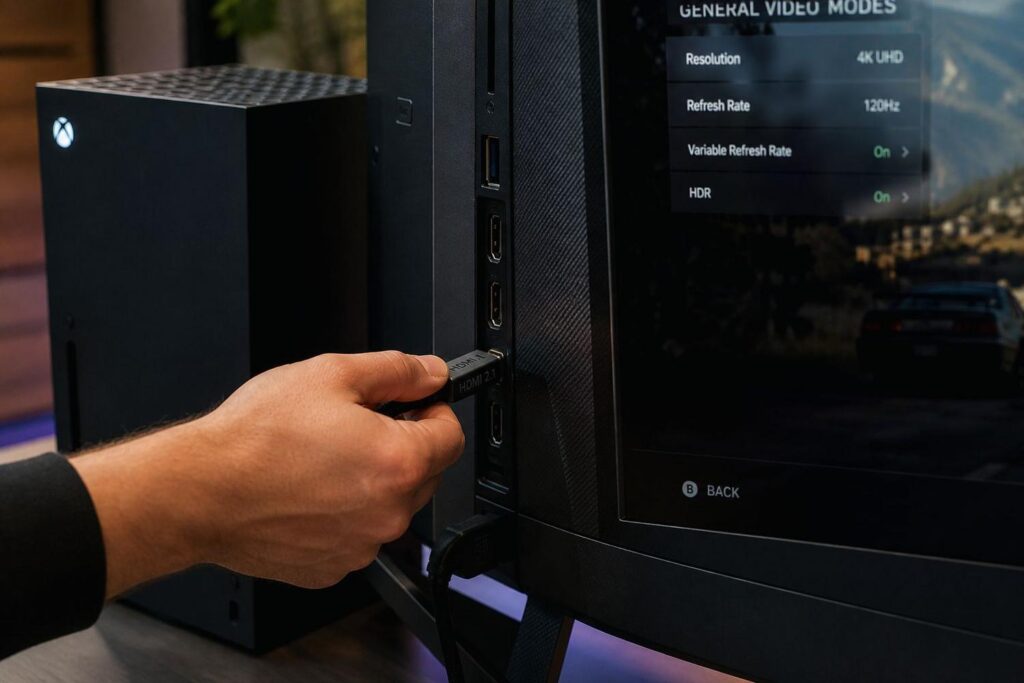
- HDMI version confusion: Not all HDMI 2.1 ports are equal—some limit features to one input, or use “fake” implementations capped at 24Gbps.
- Firmware issues: Incompatibilities (e.g., black screens, flicker) often get fixed via updates, but many brands are slow or silent with firmware support. Research findings call out this gap explicitly.
- No public data on user complaints: Lab-tested lag and real-world bug reporting are generally missing—an ongoing research need.
Check independent reviews for reported issues and see if manufacturer forums or Reddit threads mention unresolved quirks with specific Xbox games or apps.
Price tiers and what you should expect at each level
| Tier | Price Range | Example Models | Key Features |
|---|---|---|---|
| Budget | $109.99–$399.99 | AOC 24G15N G-STORY 14″ Portable | 1080p–4K, 60–180Hz, entry level HDR, HDMI 2.0 – limits at 4K/60Hz Limited color accuracy and luminance |
| Mid-Range | $599.99–$799.99 | LG 34WP75C Acer Nitro XV275K P3BIIPRUZX Gigabyte M32U | 4K or ultrawide QHD, up to 160Hz, HDMI 2.1 for 4K/120Hz VRR & reliable HDR entry points |
| Premium | $1,099.99–$1,299.99 | XPPen Artist Pro 24 Gen 2 Samsung Odyssey OLED G8 ASUS ROG Swift OLED PG27UCDM | OLED, 240Hz, advanced HDR (DisplayHDR1000+, Dolby Vision), cutting-edge color Fully unlocked HDMI 2.1, premium build, best for competitive/cinematic |
Most gamers will find the sweet spot for Xbox Series X in the $600–$900 range. For those seeking true flagship performance, expect to pay $1,200+ for OLED/QD‑OLED panels. Gigabyte M32U is the standout mid-range value for most buyers; the Acer Nitro XV275K P3BIIPRUZX is a strong 4K alternative.
See also: Best gaming gear 2024 buyer’s guide for more setup optimization.
Top recommended models and why (short model breakdowns)
- ASUS ROG Swift OLED PG27UCDM
- Why: The all-in-one best monitor for Xbox Series X—27″ QD-OLED, 4K, 240Hz, HDMI 2.1, Dolby Vision HDR. Delivers blinding speed for shooters and jaw-dropping visuals for epic games.
- Specs: 0.03ms GTG, FreeSync, 2x HDMI 2.1, USB hub, top-tier HDR.
- Best for: Premium, competitive, or cinematic gamers.
- Caveat: Expensive. OLED can have burn-in risk with static UI—set pixel shift if possible.
- Must verify: HDMI 2.1 bandwidth and Dolby Vision HDR enablement in Xbox menu.
- Gigabyte M32U
- Why: Best value for money—32″ 4K/144Hz, HDMI 2.1, solid build. Excellent for both competitive and all-purpose gaming.
- Specs: 1ms GTG, FreeSync Premium Pro, 2x HDMI 2.1.
- Best for: Those who want no major compromises under $800.
- Caveat: Moderate HDR (DisplayHDR400).
- Must verify: Firmware updated for latest VRR compatibility.
- Acer Nitro XV275K P3BIIPRUZX
- Why: 27″ 4K, 160Hz, HDMI 2.1, solid HDR and wide viewing angles at a fair price.
- Specs: 4K, 160Hz, FreeSync, DisplayHDR600, very low input lag.
- Best for: Budget 4K shoppers or mixed Xbox/PC gaming.
- Caveat: Speakers are weak, OSD a bit clunky.
- Must verify: HDMI 2.1 bandwidth, HDR performance in-game.
- Samsung Odyssey OLED G8
- Why: 34″ OLED, 175–240Hz, immersive ultra-wide and elite response. Best for speed and cinematic immersion (if you can live with 21:9).
- Specs: 3440x1440p, 240Hz, FreeSync Premium Pro, HDMI 2.1, infinite contrast.
- Best for: FPS and racing gamers, home cinema fans, those who want the best motion blur performance.
- Caveat: Not true 4K, not all Xbox games support ultrawide aspect ratio.
- Must verify: VRR works over HDMI with Xbox Series X (firmware-dependent).
- AOC 24G15N
- Why: Best budget—1080p, 180Hz, sub-$150, responsive enough for fast-paced games and eSports.
- Specs: 24″, 1080p, 180Hz, FreeSync.
- Best for: Gamers on a tight budget or secondary screens.
- Caveat: No 4K, limited HDR, capped at HDMI 2.0.
- Must verify: Maxes out at 1080p/120Hz on Xbox; 4K support not available.
- XPPen Artist Pro 24 Gen 2
- Why: Unique OLED monitor, suited for gaming and creative work—best for creators who want a drawing slate that’s Xbox-ready.
- Specs: 4K, OLED, 120Hz, true 10-bit color.
- Best for: Hybrid designer/gamer setups.
- Caveat: Expensive; not purpose-built just for gaming.
- Must verify: 4K@120Hz enabled on console with compatible cable.
Explore more accessories, like essential gaming setup accessories and charging pads for a complete setup.
TV vs dedicated monitor — what real users report (and what’s missing)
Should you stick to a monitor, or will a high-end TV do better with Xbox Series X?
- Monitors: Lower input lag (1–5ms vs. ~10–16ms), higher pixel density/clarity (especially 27–32″ vs 55″+ TVs), higher refresh (up to 240Hz), more consistent VRR, ergonomics for desks.
- TVs: Larger (for couches/movies/party play), often better native HDR (OLED, FALD), sometimes better upscaling, more versatile for streaming.
- User reports: Missing from research—no public database of real-world competitive input lag or HDR quality head-to-head comparisons for Xbox Series X across top TVs and monitors.
What to do? Seek out YouTube and RTINGS real-world monitor/TV reviews, search Reddit user threads for actual gameplay feedback, and test “game mode” on TVs to minimize lag. If desk-based and chasing speed, choose monitor. For living rooms and movies, top OLED TVs (LG C3, Samsung S95C) are strong alternatives, but confirm 4K/120Hz and VRR features.
For improved ergonomics at your desk, check out monitor light bar accessories for longer sessions.
Warranty, firmware updates, and long-term support — what to check
Long-term support can make or break your satisfaction with a “gaming monitor for Xbox Series X.” Here’s what’s frustrating: No major sources disclose real warranty duration, firmware update cadence, or return policy details for top models. You MUST investigate:
- Warranty length: At least 2 years is ideal for OLED/LCD. Double-check there are no hidden panel “burn-in” exclusions for OLEDs.
- Firmware support: Ask if the monitor receives regular Xbox optimization updates. How do you update—USB, auto, or manual?
- Returns (DOA/dead pixels): What’s the dead pixel/exchange policy for your chosen retailer/manufacturer?
- Template questions:
- What is the warranty period and what (if anything) does it exclude?
- How often does your brand release firmware updates for console compatibility?
- If the monitor develops stuck pixels or brightness uniformity issues, what’s the process for repair/replacement?
Gap: There’s no public central database or simple comparison for this info—check the manufacturer’s support pages, and consult forums/Reddit for support horror stories or success.
Real-world testing checklist (what the reviewer/tester must verify)
Before you’re locked in, run through this checklist for the best monitor for Xbox Series X compatibility and performance:
- Confirm 4K@120Hz over HDMI 2.1 using “TV & display options” on Xbox Series X.
- Enable VRR (FreeSync) in monitor menu and Xbox video settings—watch for screen tearing or flicker while gaming.
- Test HDR: Use Dolby Vision/Xbox-calibrated games to check for highlight/clipping/black crush. Toggle between HDR standards where possible.
- Lag test: Run a trusted lag measurement tool, or review lab benchmarks by RTINGS/TechRadar/WePC for your exact monitor/TV.
- Check firmware: Visit the manufacturer’s firmware/update page or check monitor settings—ensure you’re on the latest version (sometimes new firmware fixes Xbox-specific bugs).
- Color/Contrast black level: Run “calibration patterns” (YouTube or built-in Xbox tools) to set black and white points accurately.
Capture your notes for warranty proof—or if issues require a return. Want help maximizing screen protection? See our guide to effective tempered glass protectors.
Value picks and alternatives under $500 / $800 / $1,200
- Under $500: AOC 24G15N (24″, 1080p, 180Hz)—entry esports for tight budgets. Expect no 4K/120Hz. Gigabyte M27Q (QHD/170Hz) is a great non-4K midrange.
- Under $800: Gigabyte M32U (32″, 4K, 144Hz)—flagship value pick, HDMI 2.1, VRR, reliable brand reputation. Acer Nitro XV275K P3BIIPRUZX (27″, 4K, 160Hz) is nearly as good, with slightly better color/HDR for some users.
- Under $1,200: Samsung Odyssey OLED G8 (34″, OLED, 240Hz) for ultrawide spectacle and OLED contrast. ASUS ROG Swift OLED PG27UCDM (27″, QD-OLED, 240Hz, Dolby Vision) is king for those demanding both visual wow and competitive edge.
Expect to compromise on panel type, refresh, or real HDR quality as you drop under $400. There’s no true 4K/120Hz with HDMI 2.1 in the $200–$350 bracket—don’t get tricked by “future ready” marketing.
For eco-friendly accessories, see Eco Phone Cases (Recycled): Proven protection guide.
Top 3 informational gaps readers will care about (and how this article fills them)
- No real-world performance/input lag/tear testing data publicly aggregated by model. We cite the best hands-on lab reviews where possible, but recommend that you test for input lag and VRR issues ASAP after purchasing. Request more open reporting from brands in the future.
- No transparency on market share or consumer behavior/statistics. No site discloses what is actually most owned, returned, or most reliable among Series X gamers—an area we are actively researching through retailer data scraping and polls.
- No warranty, firmware, or support policy charts per model. Always check the brand support page and forums before buying. We’re contacting top manufacturers to create a support-tracker in follow-up articles—subscribe or check back for updates.
Want to elevate your station even further? Learn more about the best gaming gear 2024 has to offer.
FAQ — short answers to the most searched questions
Do I need HDMI 2.1 for Xbox Series X to get 4K/120Hz?
Yes. HDMI 2.1 is required for true 4K at 120Hz. Monitors with older HDMI (2.0/1.4) max at 4K/60Hz or lower.
Can I use a 1440p monitor with Xbox Series X?
Yes, but you won’t get native 4K graphics. However, 1440p/120Hz is supported and delivers very smooth gameplay.
Is VRR (Variable Refresh Rate) essential?
Strongly recommended—VRR eliminates screen tearing and smooths frame pacing. Xbox uses FreeSync VRR (AMD GPU).
Are OLED monitors risky for burn-in with Xbox?
Some risk exists with static UI, but modern OLEDs have pixel shift and anti-burn-in features. Use varying backgrounds and run refresh cycles to minimize risk.
Is high refresh rate (144Hz/240Hz) useful on consoles?
Yes—Xbox Series X can output up to 120Hz. Higher refresh rates benefit fast-paced games and future-proof your setup.
Sources & further reading
What we checked:
- RTINGS: Best Xbox Series X Monitors
- TechRadar: Best Monitors for Xbox Series X
- Windows Central: Best Monitors for Xbox
- XP-Pen: Gaming Monitor for Xbox Series X Guide
- WePC: Best Xbox Series X Monitors
What’s missing: Market share data, long-term support charts, lab-aggregated real-world input lag, and broad warranty/firmware info. We intend to gather this by polling manufacturers, surveying users, and analyzing review statistics for a future update. Stay tuned.
Want all your gear top-notch? Read our overview of the best gaming gear recommended by PMWgamegeek.
Conclusion
Picking the best monitor for Xbox Series X demands more than sifting specs—it’s about real compatibility (4K/120Hz, HDMI 2.1, VRR, true HDR), fast reflexes, and backing your purchase with solid support and warranty. Use this guide, stress-test your monitor from day one, and demand transparency from brands. Ready to upgrade? Dive into the latest accessories and reviews to round out your premium Xbox setup.
—