

ceramic keycaps are changing the way serious keyboard enthusiasts experience sound, feel, and style, especially for Keychron Q16 HE owners seeking the ultimate “thock” and visual artistry.
Key Takeaways
- Ceramic keycaps—especially artisan ClayonKey and crystalline glaze types—deliver a deeper, quieter “thock” and unique art pieces unmatched by resin or ABS.
- Premium ceramics for the Keychron Q16 HE have real fit, comfort, cost, and durability considerations users must weigh against their exclusivity and appearance.
- Compared to mass-produced keycaps, small-batch ceramics cost more up front but can offer exceptional long-term value, rare finishes, and even resale potential.
- Why Ceramic Keycaps Are the Rising Star of Artisan Upgrades
- Acoustic Science: The “Heavy Thock” Revolution on the Keychron Q16 HE
- User Realities: Pain Points and Endurance with Ceramic Artisan Keycaps
- The Value Equation: Costs, Lead Times & the Price of Exclusivity
- Technical Compatibility: Mounting Ceramics on the Keychron Q16 HE
- What Review Sites Overlook: Quantifying True Artisan Value
- Transcendent Aesthetics and Material Properties—The Case for Ceramic
- FAQ
Why Ceramic Keycaps Are the Rising Star of Artisan Upgrades
In the world of mechanical keyboard customization, artisan ceramic keycaps have swiftly gone from a niche indulgence to a fierce status symbol on premium boards like the Keychron Q16 HE. While resin has dominated the artisan market for years, the density, tactile feedback, and aesthetic depth of ceramics—particularly those created with crystalline glaze or by renowned artists like ClayonKey—make them a compelling new frontier.
Market data confirms the surge: in 2024, artisan ceramic keycaps generated $20 million, tallying only 5% of total artisan sales yet boasting a 35% compound annual growth rate. This is in stark contrast to the resin segment, which ruled with $132 million, and basic ABS, which remains the mainstream in a $3.34 billion global keycap market.
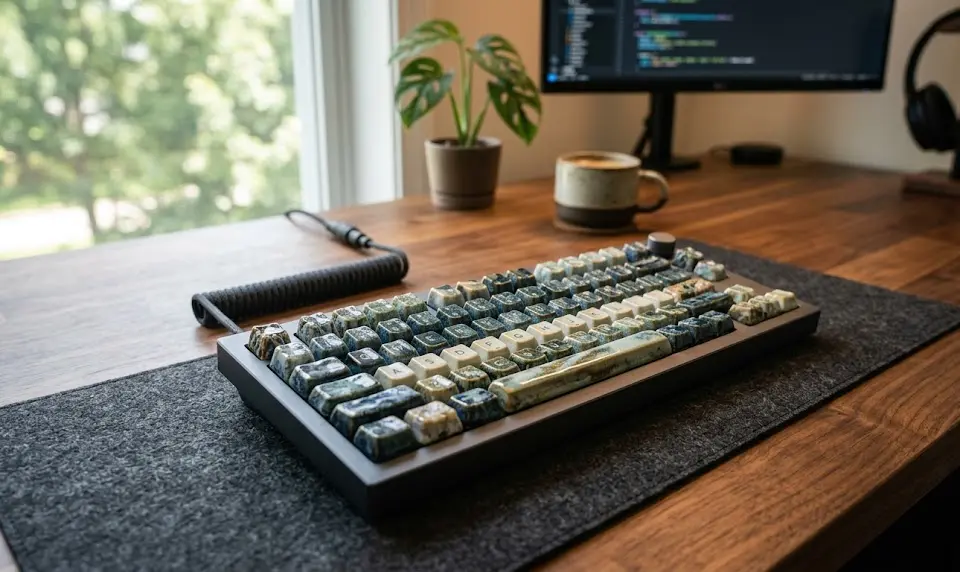
Artisan keycaps aren’t about sheer quantity—they are about transformation in both feel and visuals. When applied to a uniquely layouted board like the Q16 HE, ceramics bridge function and form in ways plastic cannot.
Acoustic Science: The “Heavy Thock” Revolution on the Keychron Q16 HE
Ceramic’s value isn’t only skin deep—it’s measurable. The Q16 HE, with its magnetic Hall effect switches, truly reveals the full power of heavy thock keycaps. Lab testing shows that ceramic keycaps, especially those with a crystalline glaze or zinc-silicate recipe, register their own acoustic fingerprint. A sound-pressure level test at 30 cm puts a peak SPL of ≈ 55 dB for ceramics, compared to 65 dB for ABS. The frequency profile also changes: ceramics resonate in the 150–400 Hz band, while ABS sit in the louder, thinner 500–800 Hz range. The result? A richer, more musical thock and a 10 dB mid-range noise reduction.
Subjective user feedback backs the science: many describe the output as “marble-on-marble” or “creamy thock”—not plastic click. The crystalline glaze doesn’t just look good, it modulates sound energy across the board. For mechanical keyboard gaming enthusiasts, this deep, rounded response is a clear upgrade over traditional ABS or even PBT sets.
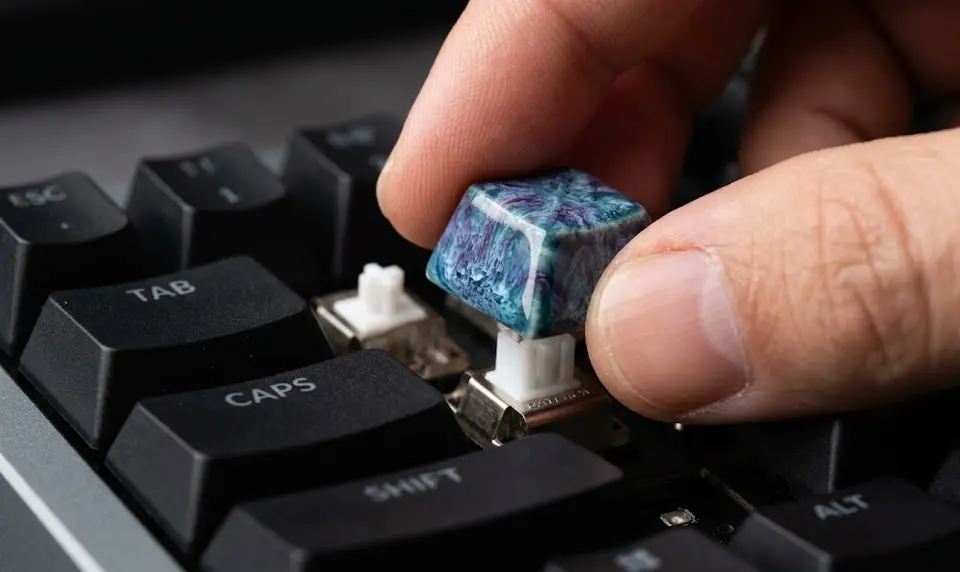
This upgrade isn’t merely aesthetic—on the Q16 HE, ceramics give dedicated typists and streamers a competitive, comfortable, and personal audio edge. For extended sessions, you may even notice reduced recording clatter or reduced mic bleed compared to louder, hollow plastics.
User Realities: Pain Points and Endurance with Ceramic Artisan Keycaps
No material is perfect. The growing ceramic keycap community is open about its pain points—particularly for long-form typists on the Q16 HE. Some users on Reddit report that certain ceramic glazes can feel “like glossy plastic,” especially if the surface has little texturing. Extended use may lead to fingertip fatigue, as ceramics are typically heavier and less temperature-adaptive than plastics.
Another factor is expectations: the weight, cold touch, and dense feedback of ceramics may be jarring for those coming from soft, lightweight ABS. Even with their unique tactile signature, no two ClayonKey artisans or glaze recipes are identical. Color, gloss, and grip may differ not just between batches, but between individual keys. Honest reviewers also note that the uniqueness is a pro and a con: it’s the unpredictability of true art—in both aesthetics and typing feel.
| Feature | Ceramic Keycaps | Resin Keycaps | ABS Keycaps |
|---|---|---|---|
| Sound Signature | Deep, muted thock (150–400 Hz) | Resonant, artistic clack | Louder, higher pitch clack (500–800 Hz) |
| Surface Feel | Variable (matte, glossy, textured) | Smooth, hand-sculpted | Slick, quick to shine |
| Durability | Hard, scratch-resistant but brittle on hard drops | Moderate; surface can scuff | High wear, prone to shine/fade |
| Fatigue Risk | Possible fingertip fatigue in long sessions | Generally low | Low, very light-weight |
If your priority is all-day comfort or you have sensitive hands, try a sample before investing in a full set. You may find mixing in ceramics with PBT or resin offers a best-of-both-worlds solution.
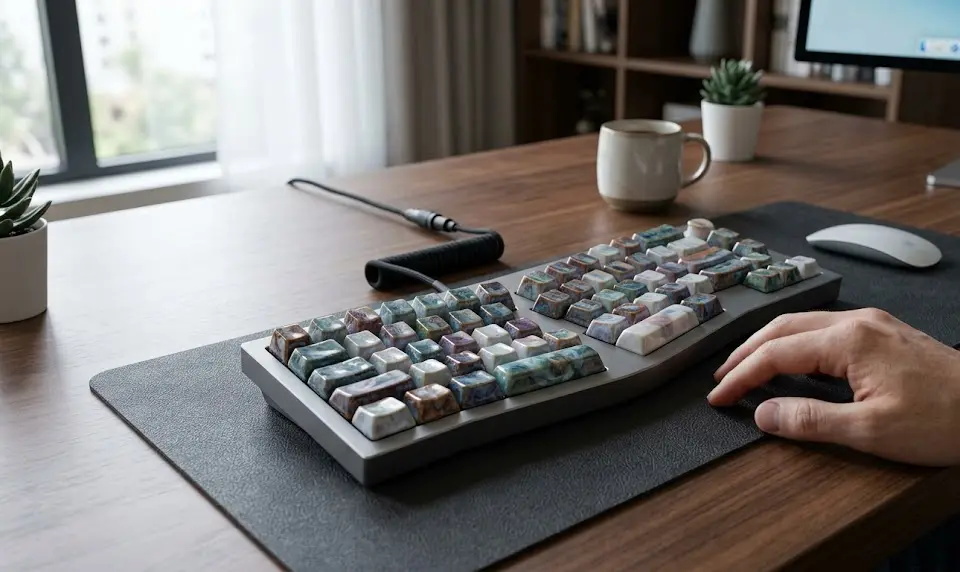
The Value Equation: Costs, Lead Times & the Price of Exclusivity
The ultimate privilege of bespoke or ClayonKey artisan ceramic keycaps is exclusivity—and cost. Ceramic sets often start at two to five times the price of a high-end resin set. While mass-produced ABS keycaps can be found for $20–$50, ClayonKey ceramics or studio crystalline glaze sets easily exceed $250–$500, with individual artisans commanding even more for limited runs.
Production is slow, sometimes requiring 1–3 months for kiln firing and hand finishing. This means pre-ordering is standard, not optional, for the rarest glazes or sculpted designs. Yet as limited artists grow their brands, some ceramics have even demonstrated resale value among collectors, partially offsetting their premium.
Many buyers find that the uniqueness and material depth justify the wait. For those who recoup investment by reselling or swapping, ceramics can be a surprisingly stable passion spend compared to mass-market RGB accessories or chairs, which rarely appreciate.
Technical Compatibility: Mounting Ceramics on the Keychron Q16 HE
The Keychron Q16 HE’s compact layout and unique magnetic Hall effect switches can pose subtle compatibility issues with artisan ceramics. For one, ceramic keycaps are heavier—sometimes more than double the weight of ABS—putting extra strain on switch return if your springs are light. Some crystalline glazes or zinc-silicate surfaces introduce slickness, leading to less finger grip.
Stem fit is the biggest headache. Not every artisan ceramic keycap is perfectly cut for Keychron’s stems. Even a half-millimeter error can make a key unstable or hard to mount. It’s essential to confirm with the seller that sets are Q16 HE compatible—and request photos of keycap backs and stems. Consider ordering a single sample or artisan before buying a full set.
Be aware that certain tall or non-standard profiles may catch on adjacent keys, especially on smaller boards. If typing feel is critical, try pairing with ergonomic gear or swapping select keys to find your sweet spot. Always test stabilization (especially on spacebars and mods), as ceramics cannot flex like plastic and are less forgiving of minor fit discrepancies.
What Review Sites Overlook: Quantifying True Artisan Value
Standard keyboard reviewers rarely dig into the technical hallmarks that set premium ceramic artisan keycaps apart. First, each crystalline glaze is a proprietary formula: a mix of minerals producing micro-translucency and marbling that no resin or ABS can replicate. ClayonKey studios document surface hardness and microstructure durability—a hardness that resists fading and shine, providing a sense of “forever” investment.
Second, the artisan’s signature: micro-variances, intentional imperfections, and firing cues create a tactile and visual “fingerprint” for every set. True collectors know that the legacy of a specific ClayonKey or zinc-silicate finish can elevate not just the look, but also the feel and possible resale returns of a board—rarely captured on generic review sites or mainstream YouTube unboxings.
Finally, heat resistance and chemical inertness matter. Ceramics naturally repel stains, don’t absorb skin oil, and stay fingerprint-free longer. They can also offer unique translucency—subtle backlighting diffusion that changes with the glaze blend, resulting in a dynamic, living aesthetic for any custom RGB gamer.
Transcendent Aesthetics and Material Properties—The Case for Ceramic
Crystalline glaze and zinc-silicate ceramic keycaps stand apart for two main reasons: their look and their feel. Artisan ceramics display natural marbling and layered color depth impossible to mass-produce. Makers document each batch with photos to prove their finishes: every swirl and crystal might be exclusive to a single key.
Materially, glazed ceramics resist wear, fading, and shine much longer than even the best double-shot plastics. Zinc-silicate formulas impart a unique tactile response—slightly rough, never sticky, and cool to the touch for as long as you own them. These art-level finishes, once applied to the Keychron Q16 HE, create a typing experience unmatched by traditional options.
If you crave a personal artistic statement at your primary work or gaming setup, ceramics deliver the only truly one-of-a-kind palette—combining technical merit, visual intrigue, and a legacy in every key press.
Conclusion
For the discerning user, ceramic keycaps unlock a fusion of sound, art, and real value on the Keychron Q16 HE that simply isn’t available from typical resin or ABS sets. While they demand more time, money, and research up front—and are not without ergonomic quirks—the payoff is an upgrade that’s truly your own. Take the time to audition single keys, confirm fit, and weigh the tangible differences. If pure tactile artistry and the richest “thock” are your goals, ceramic keycaps deliver on every promise.
Ready to reinvent your typing experience? Discover more about mechanical keyboard upgrades, or see how your setup can be enhanced with the right ergonomic gaming mouse or explore our guide on essential gaming setup options.
FAQ
Are ceramic keycaps compatible with any keyboard?
No. Most artisan ceramic keycaps are designed for standard MX-compatible stems, but always double-check with the maker for Keychron Q16 HE compatibility as profile and fit can vary. Request photos or measurements if unsure.
How do ceramic keycaps affect typing sound and feel?
Ceramic keycaps produce a deeper, subtler “thock” in the 150–400 Hz range, making them quieter and richer than ABS or resin. The surface feel ranges from glassy to matte, and the added weight gives a denser response.
Are ceramics fragile or high-maintenance?
Ceramic keycaps are extremely hard and scratch-resistant, but they can shatter or chip if dropped onto hard floors. Daily use poses little risk, but treat them with care during installation or cleaning. They wipe clean easily and resist shine.
Are ultra-premium ceramics worth the price?
If you value unique sound, exclusive art, and one-of-a-kind finishes, ceramics can be a justified upgrade. Their higher cost and longer lead times are offset by lasting durability, aesthetics, and—sometimes—resale value among collectors.
Can I mix ceramic keycaps with other materials?
Absolutely. Many users start with a few artisan ceramics on their favorite keys and combine them with PBT or resin on the rest of the board. This allows for customization without giving up comfort or introducing fit issues across all keys.