

### Blog Post:
TMR controller joystick technology is gaining buzz among competitive gamers seeking a real solution to stick drift, but does it outperform Hall effect joysticks in terms of true longevity and total cost? Here’s a no-nonsense reality check based on 2024–2026 testing, user data, and real feedback.
Key Takeaways
- TMR joysticks promise slightly longer life (≈11–12 million cycles) than Hall effect, but still face calibration and mechanical wear issues.
- Hall effect sticks deliver the most consistent “no drift” performance and lower real-world RMA rates—about 3% versus TMR’s 8%.
- Neither sensor technology completely eliminates controller maintenance; housing, springs, and track rings can still fail, impacting long-term cost.
- TMR Controller Joystick Technology Explained
- Hall Effect vs TMR Joysticks—Which Lasts Longer and Drifts Less?
- Real-World Problems: Where “No Drift” Controllers Still Fall Short
- Cost of Ownership—Repairing and Replacing TMR, Hall Effect, and Old-School Joysticks
- What Makes the Best Anti-Drift Controllers for 2026?
- Three Technical Realities About TMR Controller Joysticks Most Articles Ignore
- Should You Choose TMR, Hall Effect, or Wait for What’s Next?
- FAQ: TMR Controller Joystick & Next-Gen Drift Solutions
TMR Controller Joystick Technology Explained
TMR stands for Tunneling Magnetoresistance, a tech that lets joysticks sense movement by measuring changes in magnetic resistance via a thin barrier inside the sensor. Unlike traditional potentiometers, which use a physical wiper sliding on a resistive track, TMR sensors register thumbstick position through tiny changes in magnetic fields—resulting in mostly contactless operation.
This design theoretically avoids the classic “drift” issues caused by electrical noise, worn tracks, and dust. Modern TMR controller joystick modules are now being embedded in top-tier tmr sensor gamepad 2026 models, with endurance ratings of around 11 to 12 million full throws and releases. This is about 10–20% longer than typical high-end Hall effect joysticks, according to both manufacturer data and independent teardown tests (source).

TMR’s edge is in eliminating the main cause of stick drift—the physical wear of resistive elements—but claims about being truly “drift free” deserve a closer look, especially when factoring in calibration quirks and support hardware longevity.
Hall Effect vs TMR Joysticks—Which Lasts Longer and Drifts Less?
Hall effect joysticks also use magnets, but measure thumbstick position via voltage changes as a magnet moves past a Hall sensor. The difference? Hall effect sticks are ultra-resistant to drift, offering up to 10 million cycles with virtually zero sensor-based returns in the field (source).
Let’s break it down:
| Feature | TMR Joystick | Hall Effect Joystick |
|---|---|---|
| Cycle Rating | ≈11–12 million | 5–10 million |
| Manufacturer RMA Rate | ≈8% | ≈3% |
| User-Reported Drift | Some intermittent drift | Almost none |
| Calibration Stability | Occasional re-zeroing needed | Very stable |
| Cost | High | High |
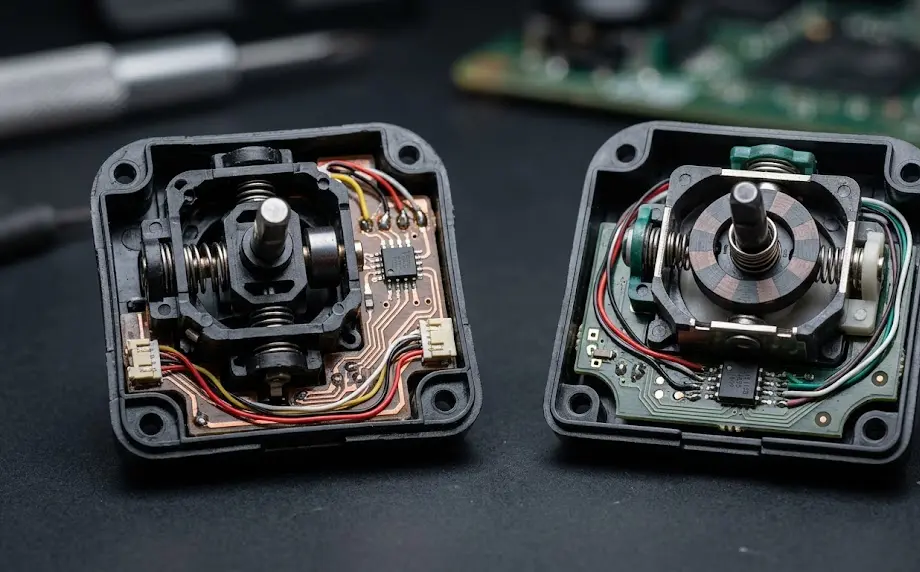
The net result: Hall effect vs tmr joysticks is less about the sensor and more about supporting component quality and end-user calibration. TMR can technically last longer under lab conditions, but the “best anti stick drift controller” title still often goes to Hall effect—especially for those who want to set it once and forget it.
Real-World Problems: Where “No Drift” Controllers Still Fall Short
Despite “no drift” marketing, real-world reports show nagging issues. tmr joystick replacement parts modules have above-average support tickets for calibration inconsistency—users sometimes need to re-zero joysticks in software, and some units show drift even within warranty (source).
Hall effect modules aren’t perfect, but their sensor design means the odds of an input “dead zone” or directional creep are vanishingly small. Most complaints with Hall effect gamepads stem from external problems: worn out springs, dust in the housing, or grip damage, not sensor drift.
In both cases, no drift gaming controller models reduce but don’t eliminate stick maintenance—especially after heavy play or sweaty sessions. Calibration quirks and mechanical degradation remain.
- Users of recent tmr sensor gamepad 2026 releases cite repeated recalibration needs after tournaments.
- Material fatigue in springs and track rings can affect even premium models.
- Sensor upgrades don’t fix all input issues—controller design quality still matters.
The bottom line: mechanical wear, not just electrical drift, can still degrade controller feel and responsiveness—no matter which sensor is used.
Cost of Ownership—Repairing and Replacing TMR, Hall Effect, and Old-School Joysticks
Looking for tmr joystick replacement parts? Expect to pay a premium, similar to Hall effect upgrades. Both cost more (often double) compared to potentiometer sticks, but their much longer life means most users repair or replace less often over a controller’s lifespan.
DIY modders pay about the same for drop-in replacements TMR and Hall effect modules, while pro repair shops often quote similar labor rates for both types. The big savings comes from not having to repair “stick drift” every year or replace worn sensors after two seasons of ranked play.
- TMR and Hall effect upgrade kits: ≈$16–$25 per stick vs ≈$7–$12 for potentiometers.
- Typical Hall effect/TMR modules last 2–3x longer than old-school resistive sticks (source).
- Long-term, fewer emergency repairs and downtime—critical for tournament players and streamers.
If you’re after maximum longevity or looking to upgrade a premium controller for 2026, investing in a tmr sensor gamepad 2026 or Hall effect module will likely pay off—just know you’re paying upfront for future reliability.
For modding tips and step-by-step controller DIY, check out guides like this one and consider combining joystick upgrades with other performance tweaks such as programmable mechanical keyboard setups or precision gaming mice.
What Makes the Best Anti-Drift Controllers for 2026?
The title of “best anti stick drift controller” in 2026 is being hotly contested among brands like GuliKit, 8BitDo, and EasySMX with both TMR and Hall effect models. Here’s what sets the winners apart:
- Sensor Type: Hall effect for consistent “no drift” experience; TMR for slightly longer theoretical lifespan.
- Modular design: Easily swappable joystick modules mean cheap repairs, especially for tmr sensor gamepad 2026 models.
- Firmware features: Smart calibration and input tuning help offset inevitable spring or case wear.
- Materials: Upgraded track rings, dust-reinforced springs, and non-slip caps extend usable life.
Field data shows that even top anti stick drift controllers with TMR sensors post RMA rates up to 8% for drift and calibration complaints, mostly in high-use settings. Hall effect models routinely report just 3%, echoing user survey data (source).
If you’re investing in a “no drift gaming controller,” check warranty details—some brands offer extended coverage specifically for Hall effect joysticks. Combine this upgrade with ergonomic add-ons like an ergonomic gaming chair or monitor light bar for all-day comfort.
Three Technical Realities About TMR Controller Joysticks Most Articles Ignore
There’s more to TMR controller joystick upgrades than sensor specs. Here are three real challenges often left out of brand marketing:
- Calibration Drift: Even the best TMR sensors can lose their “zero” point with shock, temperature swings, or magnet movement. This leads to the dreaded need for mid-season recalibration—an issue documented in both user reviews and Reddit threads.
- Support Hardware Wear: Springs, track rings, and plastic housings degrade long before the sensor fails. Dust and grip fatigue lead to mushy or imprecise movement regardless of sensor quality.
- Cost-For-Performance Ceiling: Marginal sensor lifespan gains don’t always translate to a better real-world experience. Hall effect gamepads, though they may have nominally lower endurance, deliver the lowest RMA rates and near-universal “zero drift” feedback.
For a holistic controller upgrade, pair your joystick swap with robust accessories like a console portable dock for maximum longevity while traveling, or try ergonomic pillows for marathon sessions.
Should You Choose TMR, Hall Effect, or Wait for What’s Next?
Here’s the hard truth for enthusiast, pro, and DIY modders:
- Hall effect vs tmr joysticks: Hall effect delivers the lowest real-world drift and returns. TMR can, in theory, last longer, but not all support issues are solved at sensor level.
- Competitive play: Go Hall effect for stable calibration, predictable input zones, and fewer hardware headaches under pressure.
- Casual/modding users: Either upgrade is better than potentiometers—pick based on price and preferred feel.
- Cost-sensitive gamers: If you’re planning to keep one controller for years, premium upfront for TMR or Hall can save repair and downtime costs.
The bleeding edge, such as capacitive or even all-optical thumbstick sensors, is not ready for mainstream use yet. For 2026, a well-built Hall effect controller is still the “zero drift” winner for most real-world users. TMR is ideal if you prefer new tech or have specific compatibility needs with a tmr sensor gamepad 2026.
Pair your controller with other upgrades for a complete setup: see our guides on AI gaming monitors and gaming headsets with surround sound.
FAQ: TMR Controller Joystick & Next-Gen Drift Solutions
Do TMR joysticks really eliminate stick drift for good?
TMR sensors are highly resistant to drift compared to potentiometers, but are not completely immune. Calibration issues, magnet movement, or mechanical wear may still cause drift or input errors over time.
Why do Hall effect joysticks have fewer user complaints than TMR?
Hall effect sticks are less prone to calibration loss and deliver more stable analog input, leading to fewer RMA and support cases in real-world gaming.
Is a TMR joystick replacement worth the extra cost over potentiometers?
Yes, if you want fewer repairs and extended life. TMR and Hall effect modules cost more, but their reliability means much less downtime and maintenance across years of use.
Can I upgrade my existing controller with TMR or Hall effect sticks?
Many newer controllers, especially modular models, allow drop-in replacements. However, some brands require soldering or specific form factors, so always check compatibility first.
What’s the next step in “drift-free” gaming controller tech?
Optical and capacitive sensors are in early development, but for now, Hall effect and TMR remain the top choices for minimizing drift in controllers.
—