

Asymmetrical monitor light bar is the crucial product redefining home office and creator lighting in 2024, but the technology isn’t magic—understanding it can mean the difference between endless glare and truly comfortable, productive desk time.
Key Takeaways
- Modern asymmetrical monitor light bars and wireless screenbar lights drastically reduce glare, especially critical for OLED, ultrawide, and glossy displays.
- Premium units like BenQ ScreenBar Halo 2026 and Xiaomi Mi Light Bar Wireless deliver superior cutoff optics and build, while most cheap alternatives fall short with weak mounting and uneven light.
- The biggest overlooked factor is real anti-glare testing and Flicker / PWM control—these impact actual comfort way more than marketing claims.
- Why Asymmetrical Monitor Light Bars Dominate in Home Offices (2024 Update)
- How Asymmetrical Design Reduces Glare and Screen Reflection—The Science and Real-World Experience
- What Wireless Screenbar Light Bars Add—And Where They Still Fall Short
- Performance Deep-Dive: Brightness, CRI, Flicker, and OLED Monitor Compatibility
- Value Breakdown: What You Pay for in Premium Wireless & Asymmetrical Light Bars (vs. Cheap Alternatives)
- Essentials for Multi-Monitor and Ultrawide Setups: Compatibility, Installation, and Real Use Cases
- What Top-Ranking Reviews Overlook (2024): Gaps in Real Anti-Glare Testing and OLED Suitability
- Recommendations: How to Choose the Right Asymmetrical Monitor Light Bar in 2024
- FAQ
Why Asymmetrical Monitor Light Bars Dominate in Home Offices (2024 Update)
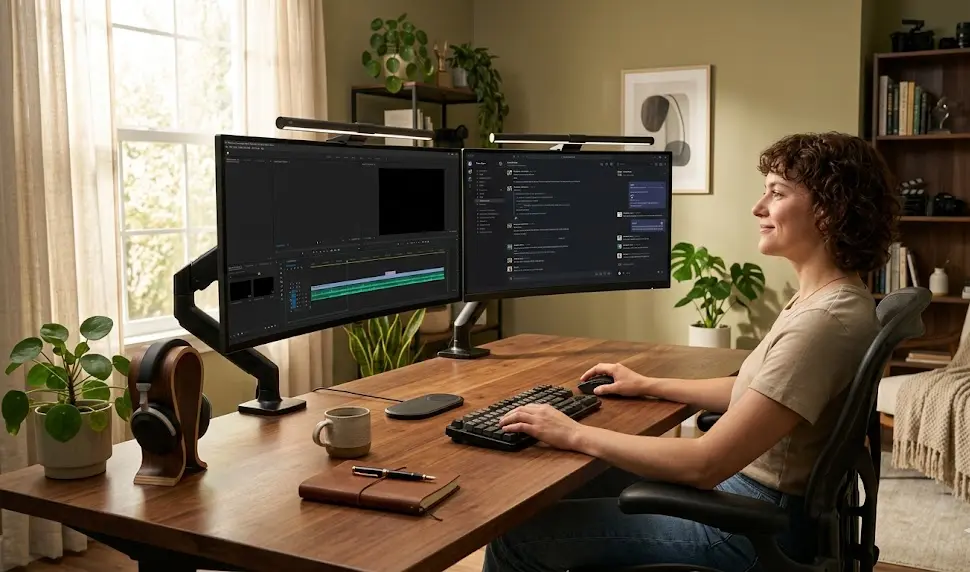
In the past year, asymmetrical monitor light bars have become the straight-up replacement for desk lamps in monitor-centric home workspaces and creative studios. Thanks to their ability to deliver focused, glare-free light across keyboards and work surfaces—without washing out screens—they are now a top-choice ergonomic upgrade for remote professionals and content creators.
This sharp rise is not hype. The global monitor light bar market is expanding at an impressive 8.2% yearly and will exceed $2.4 billion by 2033, with home offices already making up about 41% of market value, equaling roughly $330 million in 2025 alone. Major brands lead the way: BenQ controls 18% of global share, Xiaomi 11% (DataHorizzon Research).
The trend is especially strong among OLED and ultrawide users: their displays, notorious for glossy surfaces and steep angles, now demand anti-glare solutions that desk lamps simply cannot provide. No surprise, searches for the best monitor light bar for eye strain and other ergonomic work accessories are up by double digits year-on-year.
How Asymmetrical Design Reduces Glare and Screen Reflection—The Science and Real-World Experience
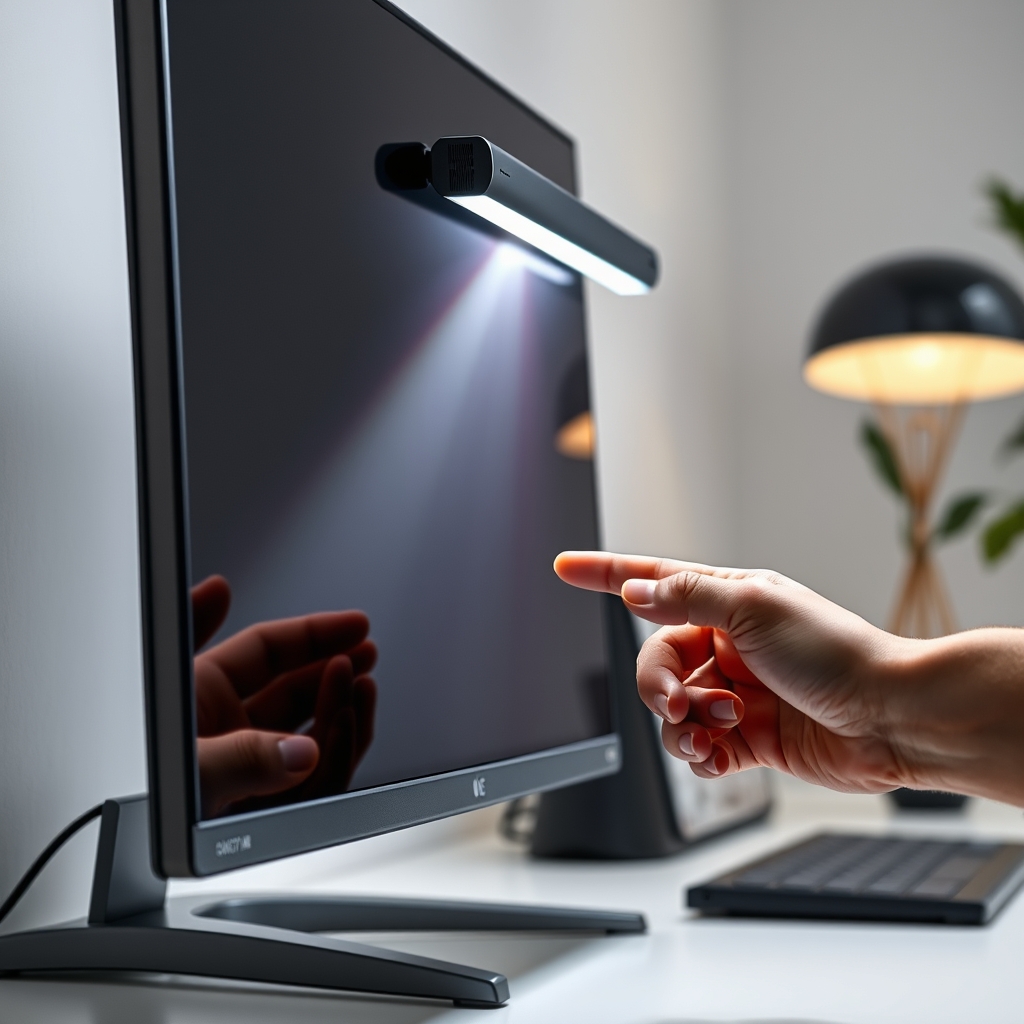
The power of an asymmetrical monitor light bar is simple: its optical housing angles the beam forward, cutting off light above a certain point so the light lands on your desk—not the screen or your eyes. No more harsh reflections or hotspots that can make OLED and glossy displays nearly unusable with a desk lamp.
Lab and user measurements agree—proper asymmetrical lighting drops measured screen reflectance by up to 80% versus desk lamps. But this only holds if the light bar provides a sharp enough cutoff, especially for curved and ultra-thin monitors. Problems arise if the optical lens is poor or the light bar doesn’t sit flush, which can let light “bleed” onto the display and cause subtle but fatiguing reflections (BenQ US, Curved Monitor Guide).
Traditional anti glare monitor lamps struggle in these scenarios, making asymmetrical designs the best desk lamp for OLED monitor needs—if you get a model with the right optical cutoff.
What Wireless Screenbar Light Bars Add—And Where They Still Fall Short
Wireless screenbar lights have revolutionized user experience in 2024. No trailing cables, and you get slick, tactile pucks or app-based controls to adjust brightness and color temperature on the fly. Installation feels almost foolproof—just clip on, power up, and pair.
The wireless screenbar light market is booming, with smart-connected models now 28% of sales, driven by 15.3% annual growth (MarketIntelo). However, the reality isn’t perfect. Many Xiaomi Mi Light Bar Wireless and similar units are plagued by:
- Lower max brightness—not always sufficient for HDR or ultra-high-res monitors
- Weaker clip security, leading to droop or wobble on thin or curved bezels
- Bluetooth or app pairing dropouts, especially in high-interference desk setups
Always check compatibility charts, especially if you run a multi-monitor or dual vertical display arrangement, or use heavy camera mounts that can interfere.
Performance Deep-Dive: Brightness, CRI, Flicker, and OLED Monitor Compatibility
Performance is where most anti glare monitor lamps and screenbars stand or fall, especially when paired with modern OLED displays. There are four pillars every serious remote professional or content creator should prioritize:
- Brightness: Most premium models deliver 420–650 lux directly to the desk; budget ones often promise more than they provide.
- CRI (Color Rendering Index): Top bars rate 90-95, key for creators needing accurate color in print, video, or photo work.
- Flicker / PWM control: OLED panels are highly susceptible to discomfort from flickering light. PWM-based dimming in most bars can trigger strobing or “lines” visible on OLED screens, particularly at lower brightness (LEDStrain Forum).
- Uniformity and cutoff: Only top-tier units like the BenQ ScreenBar Halo 2026 offer dual-illumination (front/back) and real optical hoods, crucial for wide or curved monitors.
The harsh truth: most budget bars are subpar for OLED and ultrawide setups. High flicker, uneven light spread, and weak mounting make them a false economy. If you’re running an ASUS ROG Swift OLED PG27UCDM or similar, invest in a model that’s truly compatible—not just “advertised as suitable.”
Value Breakdown: What You Pay for in Premium Wireless & Asymmetrical Light Bars (vs. Cheap Alternatives)
Confused by pricing, features, or wild spec claims? Here’s a direct comparison of popular models in 2024:
| Model | Avg. Price (USD) | Mounting Security | Brightness (lux) | Wireless Control | Compatibility |
|---|---|---|---|---|---|
| BenQ ScreenBar Halo 2026 | $170–$190 | Excellent (weighted, dual-zone) | 650 | Yes (puck) | Flat, ultrawide, most curved, OLED-safe |
| Xiaomi Mi Light Bar Wireless | $70–$90 | Good (magnetic, some flex on thin bezels) | 420 | Yes (rotary dial/app) | Flat, ultrawide, some curved (not all OLED) |
| Generic Budget Bar | $32–$45 | Poor (loose spring, plastic clip) | 220–350 | No | Flat only, problematic with curved/OLED |
Most home-office buyers still spend $32–45/unit, but cheap options are repeatedly flagged for flimsy attachments, glaring cutoffs, and subpar light measured in real-world use. If you want quality, wireless control, and anti-glare that works, expect to pay for it.
You’ll get smart home integration with leading models—perfect for layering with an AI-powered soundbar or other modern desk setup essentials.
Essentials for Multi-Monitor and Ultrawide Setups: Compatibility, Installation, and Real Use Cases
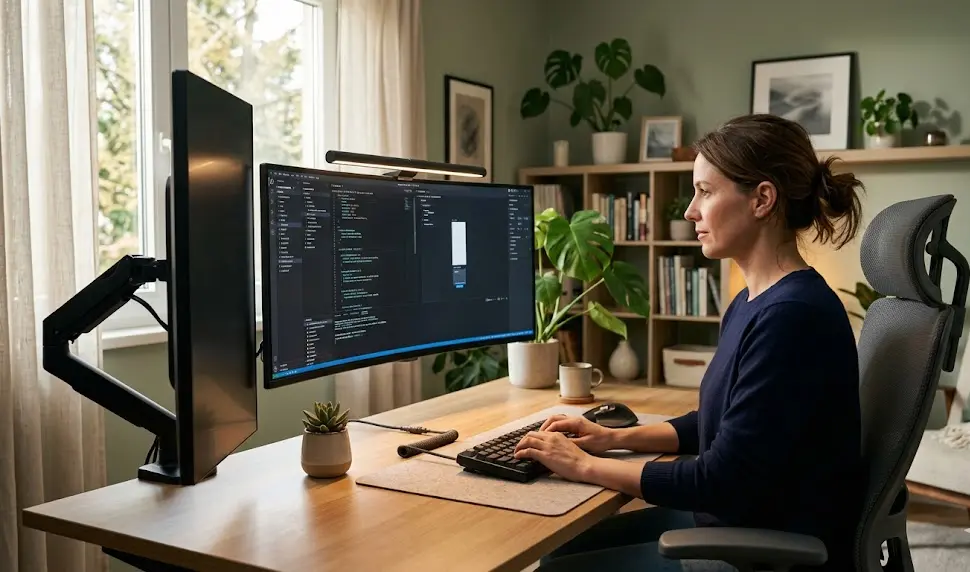
Multi-monitor and ultrawide users face unique fit challenges. Mounting a wireless screenbar light on an ultra-thin OLED, a 45-inch curved panel, or a stacked vertical array? You’ll need to look for:
- Clip design and adjustability—weighted, spring, and friction mounts all behave differently on slim, curved, and thick bezel screens
- Beam width and uniformity (for coverage on 34–49-inch wide monitors)
- Clearances for monitor-mounted webcams—the light bar can block or cast shadows if not sized carefully
- Wireless reliability: multi-monitor setups can introduce Bluetooth interference or cause battery-operated pucks to desync
Real users often report that generic bars sag over time, especially on curved ultrawide displays, and that certain premium units (like the Halo series) are deeper to guarantee beam cutoff, which affects webcam placement and monitor stacking.
Battery life and wireless responsiveness may take a hit with heavy smart home ecosystems running in the same room. For a robust solution, consider dedicated models like the Halo monitor light gaming setup or RGB gaming accessories that support integration across devices.
What Top-Ranking Reviews Overlook (2024): Gaps in Real Anti-Glare Testing and OLED Suitability
Top commercial review sites rarely go beyond feature lists or basic brightness measurements. The real-world issues that matter most—PWM flicker, genuine anti-glare performance on glossy screens, and OLED compatibility—are usually glossed over.
According to recent research and countless owner posts, the “best desk lamp for OLED monitor” is only worthy if it’s lab-tested for flicker and avoids direct or reflected light—even at low brightness settings. Several leading articles skip these constraints, leading to misleading picks.
Critical differentiators, often missing from reviews but highlighted by real users:
- PWM frequency and flicker (pain point for sensitive/long-session users)
- How well optical cutoff works in angled/glossy setups
- Fit issues with nonstandard or curved displays
Rely on peer and lab feedback, not marketing. If in doubt, check out active discussions in communities like the LEDStrain Forum, or dig into first-hand ergonomic workspace reviews.
Recommendations: How to Choose the Right Asymmetrical Monitor Light Bar in 2024
Don’t choose on looks or price alone—a strategic shopping method makes all the difference. Use these steps and the comparison chart below to get it right:
- Validate optical cutoff and asymmetry. Look for detailed photos, lab-tested diagrams, and install guides to ensure the light is truly angled away from your screen.
- Check mounting compatibility. Know your monitor thickness, curvature, and webcam placements. If possible, read or watch real install videos for your exact monitor model.
- Prioritize flicker performance and CRI specs. Especially for OLED or eye-sensitive work, choose models tested to avoid strobing or interference lines.
- Decide on wireless vs. wired. If you need cable-free, pay extra for premium build—the wireless screenbar light market is crowded, but only a few units maintain stable pairing and battery life across multi-monitor setups.
- Double-check size and coverage. For ultrawide or stacked monitors, make sure the bar beam width is enough. Dual-illumination helps, but not all are created equal.
| Scenario | Best Choice | Reason |
|---|---|---|
| Single ultrawide OLED | BenQ ScreenBar Halo 2026 | Dual beam, wireless control, proven anti-glare, high CRI |
| Budget, flat monitor | Xiaomi Mi Light Bar Wireless | Wireless puck, decent clip, fair brightness |
| Heavily curved or stacked | Weighted dual-clip bar | Secures even on aggressive curves, less fit risk |
Secure mounting and true asymmetrical optics are non-negotiable for eye strain and screen glare—never trust only marketing claims. For more setup optimization ideas, check our guides to desk setup essentials, biophilic workspace upgrades, and ergonomic gaming chairs to round out your healthy workflow.
FAQ
What’s the main advantage of an asymmetrical monitor light bar over a traditional desk lamp?
Asymmetrical monitor light bars direct light onto your desk and away from the screen, dramatically reducing glare and reflections. Traditional desk lamps cast light in all directions, causing unwanted screen reflections and eye strain—especially on glossy or OLED displays.
Are wireless screenbar lights bright enough for content creation or spreadsheet work?
This depends on the model. Premium units like the BenQ Halo or Xiaomi Mi Light Bar Wireless usually offer enough brightness (400+ lux), but many budget wireless bars are underpowered, especially for wide or HDR monitors. Always check independent lux measurements.
Will these work with my curved or ultrathin monitor?
Not all light bars fit or perform well with curved/ultrathin screens. Look for units with variable or weighted mounting, and make sure the light cutoff is sharp enough to prevent “screen bleed.” Some bars may slide or let light hit the screen improperly if the mounting is poor.
Can an asymmetrical monitor light bar cause flicker on my OLED monitor?
Some can, especially budget ones using low-frequency PWM dimming. This can produce visible flicker or strobing on OLEDs, leading to eye discomfort over long sessions. Look for models specifically noted for high-frequency or flicker-free performance.
Is it easy to install a wireless screenbar light with a webcam or dual monitor setup?
Installation can be tricky. Larger or deeper bars may block top-mounted webcams, and mounting clips may not fit well on stacked or ultrawide displays. Always measure your setup first and look for models with adjustable or offset mounting options.

[…] those who value ergonomics in their workspace, you might also like our guides on felt desk mats and monitor light bars for a more comfortable tech […]